The Story
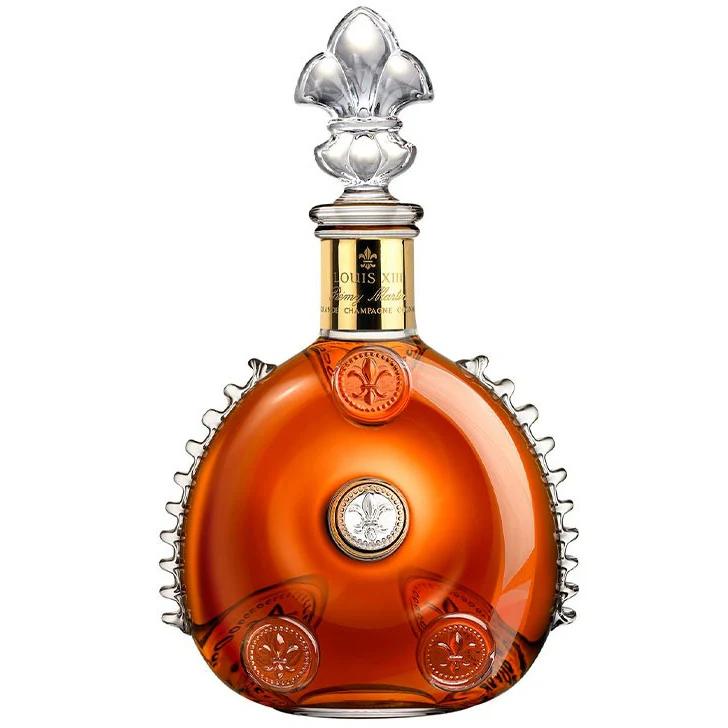
750ml. LOUIS XIII. Rémy Martin — the world's most prestigious cognac in the standard 750ml format, presenting a blend of up to 1,200 individual Grande Champagne eaux-de-vie aged between 40 and 100 years in French Limousin oak tierçons — the work of four generations of Rémy Martin Cellar Masters in a hand-crafted Baccarat crystal decanter.
LOUIS XIII has been produced since 1874 and takes its name from Louis XIII of France, whose 17th-century portrait appears on every decanter. Each bottle represents the work of no single individual — the eaux-de-vie age for up to a century, which means no Cellar Master alive today will live to blend what is currently aging in the Rémy Martin tierçons. It is a generational relay: each Cellar Master selects and sets aside their finest eau-de-vie for successors to eventually blend.
The Baccarat crystal decanter is individually handmade and filled by hand at the Rémy Martin estate. The pewter stopper is sealed with wax. Every component — liquid, vessel, and presentation — represents the apex of its category.
Specs
- House: Rémy Martin, Cognac, France (est. 1724)
- Style: Grande Champagne Cognac
- Blend: Up to 1,200 eaux-de-vie aged 40–100 years
- Vessel: Baccarat crystal decanter, individually handmade
- ABV: 40%
- Size: 750ml
Browse all Rémy Martin at Wooden Cork.
Frequently Asked Questions
- Why does LOUIS XIII require four generations of Cellar Masters? The youngest eaux-de-vie in LOUIS XIII are 40 years old — a maturation span that exceeds a typical professional career. Each generation of Cellar Masters selects the finest stocks for future blending by their successors. No one person oversees the full cycle from distillation to final blend.
- How does the standard 750ml compare to the Jeroboam 3L and Magnum 1.75L also in the collection? All three contain the same LOUIS XIII liquid — the difference is format. The 750ml is the standard decanter; the 1.75L Magnum and 3L Jeroboam require specially designed larger Baccarat crystal vessels. The 750ml is the most accessible format of the three.
Description
750ml. LOUIS XIII. Rémy Martin — the world's most prestigious cognac in the standard 750ml format, presenting a blend of up to 1,200 individual Grande Champagne eaux-de-vie aged between 40 and 100 years in French Limousin oak tierçons — the work of four generations of Rémy Martin Cellar Masters in a hand-crafted Baccarat crystal decanter.
LOUIS XIII has been produced since 1874 and takes its name from Louis XIII of France, whose 17th-century portrait appears on every decanter. Each bottle represents the work of no single individual — the eaux-de-vie age for up to a century, which means no Cellar Master alive today will live to blend what is currently aging in the Rémy Martin tierçons. It is a generational relay: each Cellar Master selects and sets aside their finest eau-de-vie for successors to eventually blend.
The Baccarat crystal decanter is individually handmade and filled by hand at the Rémy Martin estate. The pewter stopper is sealed with wax. Every component — liquid, vessel, and presentation — represents the apex of its category.
Specs
- House: Rémy Martin, Cognac, France (est. 1724)
- Style: Grande Champagne Cognac
- Blend: Up to 1,200 eaux-de-vie aged 40–100 years
- Vessel: Baccarat crystal decanter, individually handmade
- ABV: 40%
- Size: 750ml
Browse all Rémy Martin at Wooden Cork.
Frequently Asked Questions
- Why does LOUIS XIII require four generations of Cellar Masters? The youngest eaux-de-vie in LOUIS XIII are 40 years old — a maturation span that exceeds a typical professional career. Each generation of Cellar Masters selects the finest stocks for future blending by their successors. No one person oversees the full cycle from distillation to final blend.
- How does the standard 750ml compare to the Jeroboam 3L and Magnum 1.75L also in the collection? All three contain the same LOUIS XIII liquid — the difference is format. The 750ml is the standard decanter; the 1.75L Magnum and 3L Jeroboam require specially designed larger Baccarat crystal vessels. The 750ml is the most accessible format of the three.